















Oct 27 2026 | Tags: Leadership Development, Emotional Intelligence
The Missing Capital Behind High Performance
EMOTIONAL CAPITAL RESEARCH INSIGHTS SERIES
APA WORK IN AMERICA 2026 | EMOTIONAL CAPITAL PERSPECTIVE
What if the greatest untapped source of performance in your organisation isn't what your people know, but something that determines how effectively they use what they know?
A remarkable new report from the American Psychological Association suggests we may have been overlooking an important form of capital.
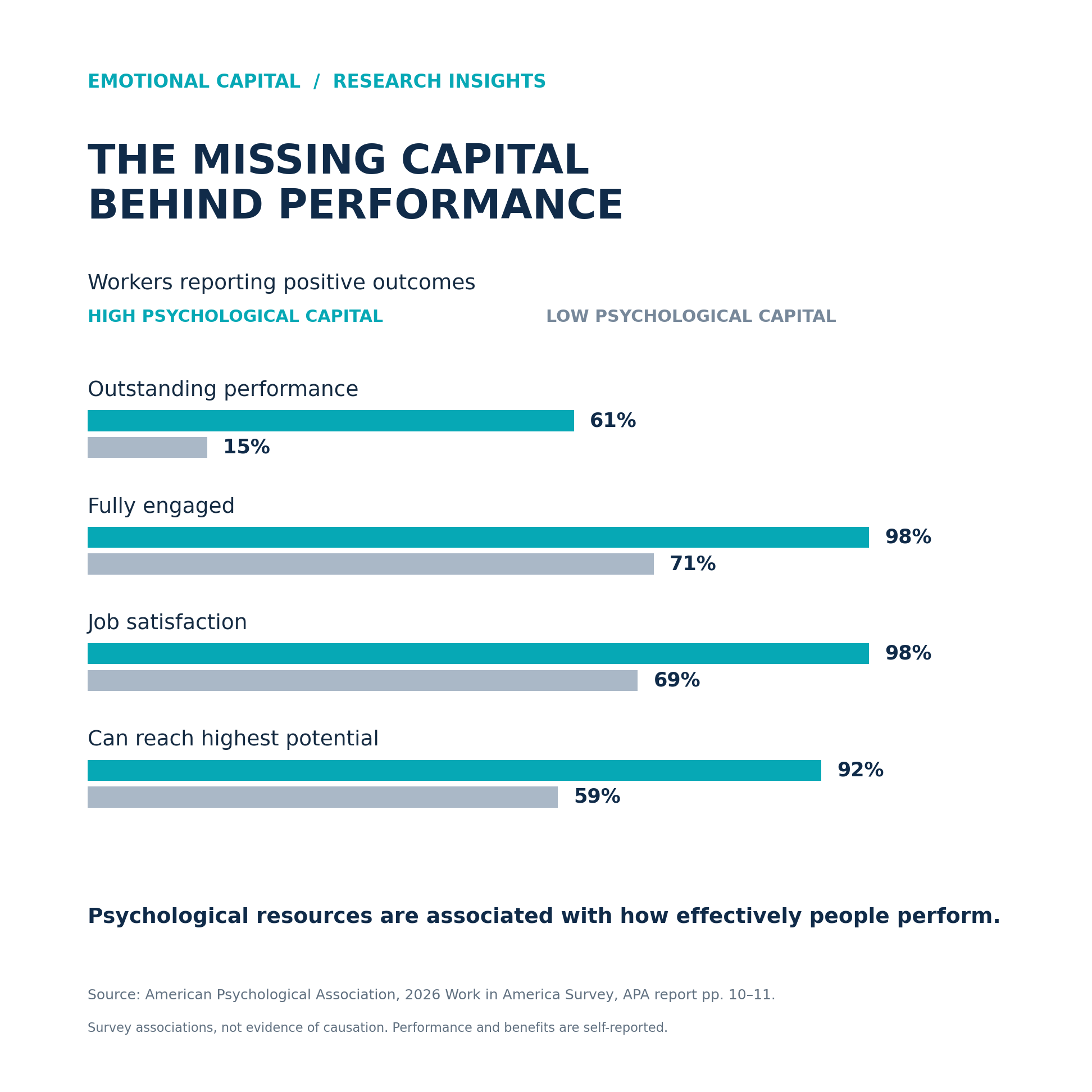
In its September 2026 Work in America survey of 2,009 employed Americans, the APA found that 61% of workers with high Psychological Capital rated their performance as outstanding, compared with just 15% of those with low Psychological Capital.
That's a fourfold difference in the proportion reporting outstanding performance.
The pattern was equally striking elsewhere:
- 98% versus 71% reported feeling fully engaged at work.
- 98% versus 69% were satisfied with their jobs.
- 92% versus 59% believed they could reach their highest potential.
The APA measured Psychological Capital using four capacities: hope, efficacy, resilience and optimism. The findings are associations based on self-reports, not proof that these capacities caused better performance. But the consistency of the pattern is remarkable.
And it points to something I've been investigating for more than two decades.
The most valuable thing about human capital may be the emotional capital that enables us to use it.
The intellectual roots of this idea reach back to Adam Smith's recognition that acquired abilities are a form of productive capital. Economists subsequently developed the concept of Human Capital, particularly through Gary Becker, to explain the economic value of education, knowledge and skills. Sociologists such as Pierre Bourdieu and James Coleman extended this thinking through Social Capital, recognising the productive value of relationships, networks and trust.
My work on Emotional Capital takes this argument further.
Knowledge and relationships are valuable assets. But what enables us to turn them into productive action?
Confidence to act. Self-control under pressure. Empathy to understand others. Adaptability when circumstances change. The ability to build trust, recover from setbacks and sustain optimism.
These are among the ten measurable emotional competencies that make up our Emotional Capital model.
Emotional Capital is an enabling capital. It helps determine how effectively our other assets are put to work.
The APA's findings don't directly test this broader model, but they offer compelling evidence that psychological resources belong in the conversation about economic value and performance.
For years, organisations have invested heavily in what people know.
Perhaps the next great opportunity is to invest just as seriously in what enables people to make the most of what they know.
What would change in your organisation if emotional capabilities were treated as productive assets rather than soft skills?
Source: American Psychological Association, 2026 Work in America Survey, Beyond Skills and Experience: Psychological Capital in the Modern Workplace, pp. 10–12.
Share on:


